

Lung surgery is advised when a disease in the lung, pleura (the lining around the lung), or chest cannot be treated well with medicines alone. Today, many lung operations are done through small cuts using keyhole (VATS) techniques, which means less pain and a faster return to normal life.
In this guide, we explain when lung surgery is needed, the main types, how the surgery is done, the risks, and what recovery looks like.
What Is Lung Surgery?
Lung surgery, also called thoracic surgery, is an operation to remove, repair, or treat a diseased part of the lung or the surrounding chest structures. The goal may be to cure a disease (such as early lung cancer), to diagnose an unclear lung problem, or to relieve symptoms and prevent complications.
When Is Lung Surgery Needed?
Your surgeon may recommend surgery for:
- Lung cancer, especially in the early stages, when removing the tumour offers the best chance of cure
- Lung nodules or masses that need a biopsy or removal to confirm the diagnosis
- Empyema or pus in the chest, and infected collections that don’t clear with drainage and antibiotics
- Lung abscess, bronchiectasis, or tuberculosis damage that causes repeated infection or bleeding
- Pleural effusion (fluid around the lung) that keeps coming back
- Pneumothorax (collapsed lung) that recurs or doesn’t heal
- Chest wall and mediastinal tumours, including thymus and other growths in the middle of the chest
- Hydatid cyst of the lung and other cystic diseases
- Severe emphysema in carefully selected patients
Symptoms That Need Medical Attention
See a doctor without delay if you have:
- A cough lasting more than 2-3 weeks
- Coughing up blood
- Unexplained weight loss or loss of appetite
- Chest pain or breathlessness
- Repeated chest infections
- Fever with chest pain or heavy sputum
A chest X-ray or CT scan can often find the cause early. Coughing up blood or sudden breathlessness needs urgent care.
Types of Lung Surgery
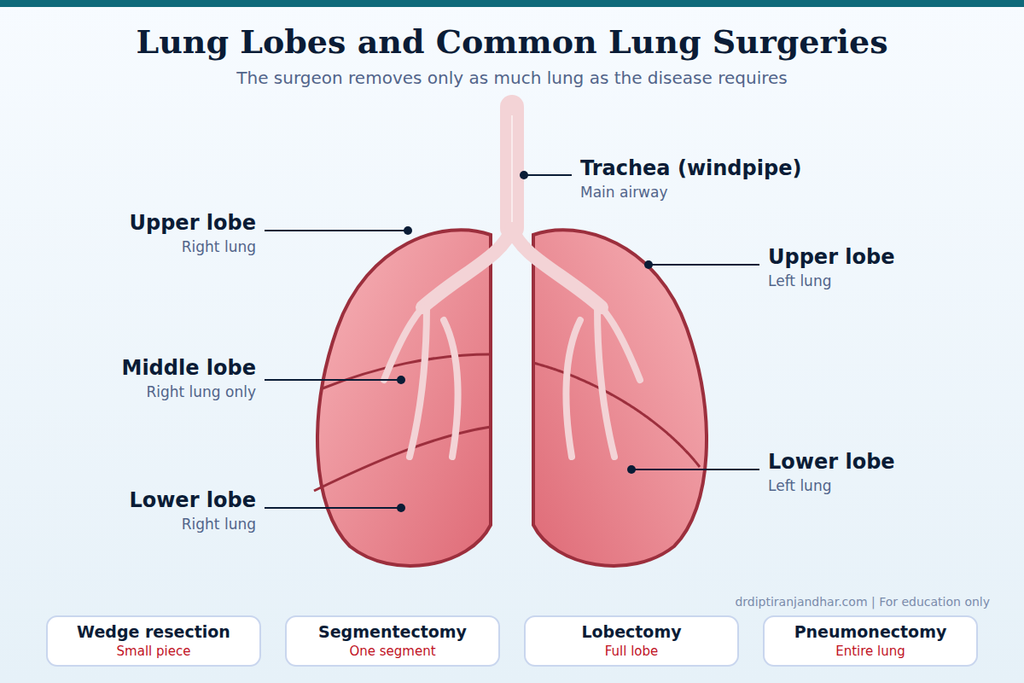
1. Wedge resection. A small, wedge-shaped piece of lung is removed. It is used for small nodules or when the patient cannot tolerate a larger operation.
2. Segmentectomy. One segment of a lobe is removed, which preserves more healthy lung.
3. Lobectomy. A full lobe of the lung is removed. This is the most common operation for early lung cancer.
4. Pneumonectomy. The entire lung is removed. It is done only when disease cannot be treated any other way.
5. Decortication. The thick, infected layer on the lung surface is removed in empyema or a trapped lung, so that the lung can expand again.
6. Pleurectomy / pleurodesis. Used for recurrent pneumothorax or fluid collections, to help the lung stay attached to the chest wall.
7. Mediastinal and chest wall tumour surgery. Removal of growths from the central chest or chest wall.
VATS (Keyhole) vs Open Lung Surgery
| VATS (keyhole) | Open (thoracotomy) | |
| Incisions | A few small cuts | One larger cut between the ribs |
| Pain | Usually less | Usually more |
| Hospital stay | Often shorter | Often longer |
| Recovery | Faster | Slower |
Not every patient is suitable for keyhole surgery. Large tumours, previous chest surgery, or heavy infection may need an open approach. Your surgeon decides after reviewing your scans.
How Is the Diagnosis Made?
- Chest X-ray and CT scan to see the size and location of the problem
- PET-CT scan to check whether a growth has spread
- Bronchoscopy to look inside the airways and take samples
- Biopsy to confirm the diagnosis
- Pulmonary function tests (PFT) to check whether your lungs can safely handle surgery
What Happens During Surgery?
Lung surgery is performed under general anaesthesia. For VATS, the surgeon makes a few small cuts and uses a camera and special instruments. For open surgery, one larger incision is made between the ribs. The diseased part is removed, the airway and lung are sealed, and a chest drain tube is placed to remove air and fluid while the lung heals. Most operations take a few hours.
Risks and Complications
Lung surgery is safe in experienced hands, but like any major surgery it carries risks. These include air leak from the lung, bleeding, infection, irregular heart rhythm, pneumonia, and breathing difficulty. Careful testing before surgery, good pain control, and early breathing exercises after it all help lower these risks. Smokers and people with weak lung function are at higher risk, so preparation matters.
Recovery After Lung Surgery
- Hospital stay: often a few days to about a week, depending on the surgery
- Chest drain: removed once air leak and fluid have settled
- Breathing exercises and walking: start early and help prevent chest infection
- Return to light work: around 3-6 weeks, sooner after keyhole surgery
- Full recovery: a few weeks to a few months
- Follow-up: regular check-ups, and additional treatment such as chemotherapy if the diagnosis requires it
Avoid heavy lifting until your surgeon clears you. Stopping smoking before and after surgery is one of the most important things you can do for healing.
How to Protect Your Lung Health
- Do not smoke, and avoid second-hand smoke
- Get a persistent cough checked early
- Complete tuberculosis treatment fully
- Avoid dust, fumes, and polluted air where possible
- Get vaccinated against flu and pneumonia if advised
- Do regular breathing exercises and stay active
Why Choose Dr. Dipti Ranjan Dhar for Lung Surgery in Bhubaneswar?
Lung surgery needs careful assessment, skilled technique, and good post-operative care. Dr. Dipti Ranjan Dhar is a Cardio-Thoracic & Vascular Surgeon who consults at Sunshine Hospital, Bhubaneswar. He treats a wide range of chest and lung conditions and explains each step clearly to patients and families.
Have a lung scan report you’re worried about, or been told you need lung surgery? Book an appointment on WhatsApp or visit the Lung Surgery page.
Frequently Asked Questions
Is lung surgery a major operation?
Yes, but modern keyhole techniques have made it much easier on patients, and outcomes are good when surgery is planned properly.
Can I live normally with a part of my lung removed?
Yes. Most people lead a normal life after a lobectomy, because the remaining lung works to compensate.
What is VATS surgery?
VATS (video-assisted thoracoscopic surgery) is keyhole lung surgery done through small cuts with a camera. It usually means less pain and quicker recovery.
How long does recovery take?
Hospital stay is usually a few days to a week. Most people return to normal activity in a few weeks to a couple of months.
Is lung cancer surgery curable?
Early-stage lung cancer can often be cured with surgery. The chances are best when it is found early, which is why a persistent cough should never be ignored.
What is the cost of lung surgery in Bhubaneswar?
It depends on the type of surgery, whether keyhole or open, the hospital stay, and room category. A consultation after reviewing your reports will give you an accurate estimate.
Disclaimer: This article is for general education and is not a substitute for medical advice. Please consult a qualified cardiac surgeon for your individual case.